

88% of Thai HR Leaders Say Global Collaboration Is Increasing the Need for English ELSA Business recommends preparing client-facing employees to speak up in meetings with multinational clients, partners and contractors.
BANGKOK, 27 October 2026 – Eighty-eight per cent of surveyed Thai HR leaders say increasing global collaboration is raising the need for English in their organisations, according to ETS’s Thailand findings. For employees in client-facing roles, this includes meeting and working with multinational clients, partners and contractors.
Pearson’s Global English Proficiency Report 2024 reports an average speaking score of 34 on its 10-90 Global Scale of English for the test takers sampled in Thailand, within the CEFR A2 band. A2 describes the ability to manage simple, routine exchanges, with limited ability to sustain a conversation independently. This is a test-taker average, not a measure of national proficiency or the level of every participant.
When employees struggle to respond in a meeting, requirements may go unclarified and concerns unraised. In ELSA’s view, this can contribute to project delays or late reporting of safety concerns. ELSA Business recommends practising the exchanges each role requires, from clarifying instructions to explaining technical issues and raising concerns.
An engineering consultancy in Thailand introduced ELSA Business for site engineers, safety officers and project staff who work with multinational clients and contractors, with the aim of building speaking confidence and more active participation in site meetings and client discussions. Within three months, 94% of participants improved their ELSA English Proficiency Score, with 100% licence activation and 94% learner engagement in the third month.
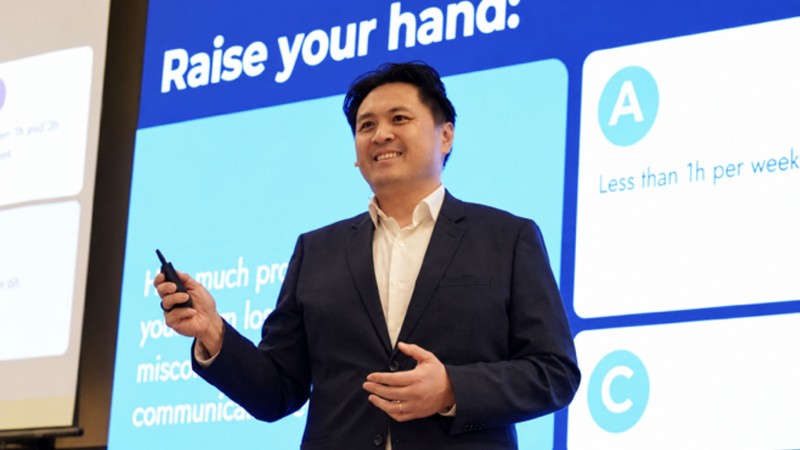
“Global collaboration happens in conversation, and conversation is where confidence matters,” said Fai Tang, Managing Director Southeast Asia, ELSA. “An employee can prepare a written report in their own time. A question in a meeting arrives without warning. Our view is that preparation should match that reality, which means practising the conversations a role actually produces.”
Three steps ELSA suggests for HR and L&D leaders:
- Map the moments that matter: Identify the conversations each role needs to handle, such as client progress meetings, contractor briefings and project handovers, and build practice around them.
- Practise in context: Provide repeated practice in those situations, with opportunities to apply the learning at work.
- Measure what changes: Assess whether employees can ask, challenge and clarify in real meetings, not only whether they attended or passed a test.
ELSA Business gives employees private, role-based practice in spoken English, with immediate feedback on pronunciation, intonation and fluency. Learning paths are set against the organisation’s own requirements and adjust as employees progress. Organisations can build practice scenarios from their own manuals and procedures, and HR teams can follow speaking progress department by department.


